Zero Is a Special Net Promoter® Number
When someone gives you a zero on NPS, they aren't just rating you, they're sending a message. The data backs it up: response rates spike at zero across four companies, and comment rates climb as scores fall, in a remarkably consistent shape. Here's the analysis, why it matters for service recovery design, and the case for treating zeros as a separate workflow.

On this page
One may be the loneliest number but, when it comes to Net Promoter, zero is more special than you realise.
I’ve been saying for a while now that when someone gives you a zero in a Net Promoter Score® survey they are not just providing feedback, they are sending you a message. If you choose to respond to that message you can turn people around dramatically.
Every explainer on Net Promoter Score tells you to follow up quickly on detractors. That advice is not wrong, but it does miss the nuance of the zero.
Recently I ran the numbers to get under the covers on this subject and found some very interesting results.
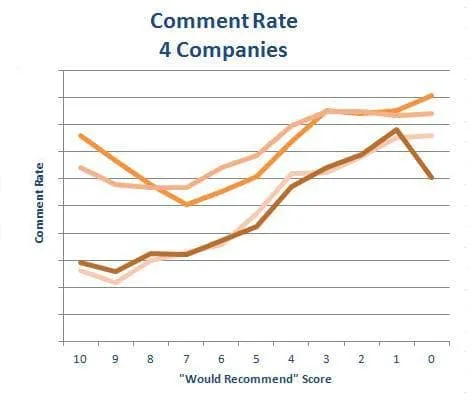
I looked at several sets of data and charted them in two ways: response rate by score and comment rate by score. See below for the charts.
The first thing you notice is that the shape of the curves is remarkably similar across all of the companies. Of course the exact proportions of each score are different as each organisation has a different NPS but the shape of the curve is very similar.
Response Rates Spike at Scores 8, 5 and 0
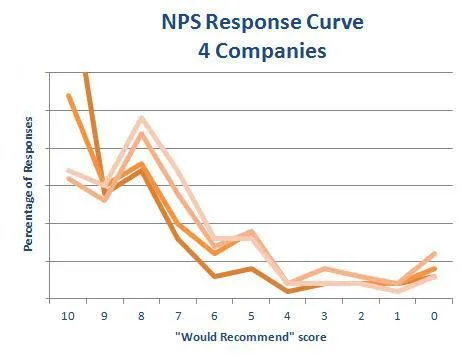
You can see three clear kicks in the curve at 8, 5 and 0 for all the companies. If you had a normal response curve, those kicks should not be there. So where do they come from?
NPS = 8 – Happy But Not Super Happy
The kick at score 8 indicates people who are moderately happy but are not going near the 9 or 10, so they lump together at 8, a good but not great score.
NPS = 5 – Meet Mr. Even Steven
Yep, if you’re not sure where to place your bet, the middle, 5, is as good as anywhere. You could do better with these folks but they’re not getting too excited today.
NPS = 0 – I’m Letting You Know I’m Really, Really Unhappy, But Still Engaged!
The kick at zero is interesting because if all things were equal the number of people just a little bit less happy than the 1s would be just a little bit lower, in line with the rest of the curve. But it’s not: there are twice or three times as many zeros as you might expect.
Maybe they could have given you a 1 or a 2 but not these folks: only a zero would cut it.
While it might seem that the bounce in the rate at zero is a negative, you should instead view it positively.
These respondents are showing that they are still engaged with your organisation, even if they are unhappy at the moment.
A disengaged, very unhappy customer would just have ignored the survey request and moved their business elsewhere. On the other hand, the zeros can be turned around: all you have to do is re-engage with them.
Comment Rates Rise as Customers Get Less Happy
Comment rates rise as scores fall: the same clear theme holds across all four organisations. The really good news is that as people are less and less happy they tell you more and more about what you’re doing wrong and how to make it right.
Sure, a proportion of these respondents are just letting off steam, but many of them are sincerely trying to help you. They are spending time, sometimes several paragraphs’ worth of time, to explain what happened and why they are not happy.
At the lowest end of the scale, 80% or 90% of respondents are providing commentary-based feedback. If you are an organisation that wants to improve its score, then this is exactly what you need: Information.
Build a Proactive Recovery Process for Every Zero
Those zeros are practically begging you to improve.
They are still engaged and ready to provide more feedback – so call them.
Make sure you set up a proactive service recovery process to contact all of the zeros. Based on our experience with other organisations, you will be surprised at how positive the response will be.
The payoff is measurable. CustomerGauge research found B2B brands see an 8.5% increase in retention when they close the loop with all customers.
Of course you’re not going to save everyone, but you will save quite a few customers. Plus the calls will not be as confronting as you might expect. After the respondent picks themselves up off the floor from the shock that someone actually read their feedback, they will at least discuss the issues with you and give you the opportunity to turn them around.
Remember, until now all of their feedback has gone into a black hole and no one has ever called them back, so you’ve already proven that you’re worth a second chance.
Also, when you do turn them around, they will become your most loyal and vocal advocates. Do you really want to miss that opportunity?
So you see, Zero really is a special number. Are you using it to your advantage?
How the Data Were Collected
In these data sets there were good volumes of responses (100s or 1,000s), from both B2C and B2B organisations. The data were collected in Australia. For how sample size affects how much you can trust a single company’s curve, see our guide to margin of error for NPS.
The questions included:
- “Would recommend” question
- Open Comment question