9 Reasons Net Promoter Score® is Important to Your Business
Before you spend time and money implementing NPS, you need to be sure it deserves a place in your business. Here are nine evidence-backed reasons it probably does: shareholder value, revenue prediction, organisational loyalty, and a couple that surprise most people.

On this page
There is a lot written about Net Promoter Score: what it is, how to use it, who uses it, etc.
But before you start spending time and money implementing NPS in your business, you need to satisfy yourself that NPS® will work for your company.
This post outlines exactly why you should care about NPS in your business.
Ask ten people why NPS matters and nine will quote the same handful of numbers: a Bain study, a McKinsey estimate, a Temkin benchmark.
Line them up and they look like they disagree with each other, but that’s only because they come from different companies, different industries and different survey methods.
The link between NPS and business success is real and well documented.
Just be careful which evidence you rely on: external benchmarks rarely compare like with like.
High NPS Companies Generate Shareholder Value Faster than Low NPS Companies
Companies that lead their industries in terms of NPS levels also tend to lead value creation for their shareholders. What’s good for customers is also good for investors.
As proof of this, in his latest book Winning on Purpose, Fred Reichheld outlined his FREDSI portfolio of stocks. The FREDSI is a stock portfolio based on companies that achieve the highest NPS in their respective industries.
Reichheld rebalances companies in the FREDSI each year based on their NPS levels.
Since 2011, the year the FREDSI was created, the portfolio has averaged a 26% per annum return. This substantially exceeds the Morningstar “best mutual funds” return of 19% per annum.
It also equates to a 10.1 times return over ten years, almost triple the Vanguard Total Stock Index return of 3.6 times in the same period.
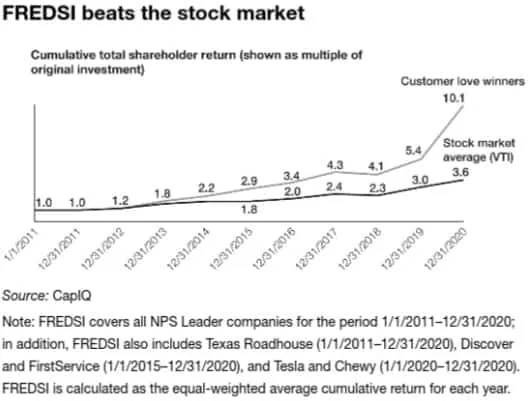
Fred Reichheld’s FREDSI portfolio against the stock market, 2011 to 2020
NPS Predicts Company Revenue
The primary reason NPS is important is that it predicts how company revenue will change over time.
The history behind NPS is that it was developed as a direct response to the need for a simple survey approach that would predict the loyalty of a customer. With so many companies using the approach there is ample proof that improvements in NPS do indeed lead to increased revenue, and also lower costs.
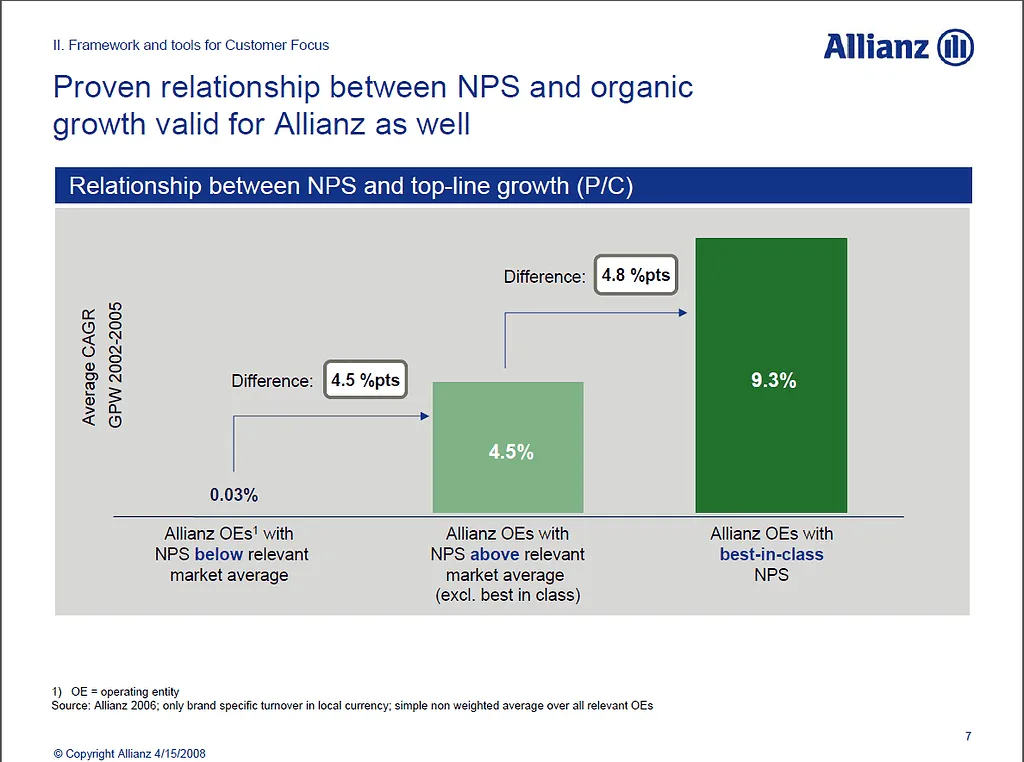
This chart shows revenue growth directly linked to NPS
Two of our own clients show the same pattern, tracked the same way each quarter rather than stitched together from different studies. AccessPay lifted its NPS from 15 to 53 in two years; Zip Water UK moved from +2 to +73 in three.
Both businesses point to the same driver: fixing the specific issues customers raised, not chasing the score itself.
NPS Predicts Other Key Customer Attributes
NPS is widely known as a predictor of Customer Loyalty but it is also a key predictor many other key business attributes, including:
- Tech Company purchasing momentum (source)
- Rate adequacy (i.e. gross margin) in insurance companies (source).
- Telco company churn reduction (source)
- Television ratings (source)
- Telco debtors days (source)
- Operational efficiency (i.e. cost) (source)
NPS Is Easier to Use than Other Loyalty Predictors
NPS is not the first (nor probably the last) attempt to use survey data to predict customer loyalty but it is far easier to use than competing measures.
With enough data and advanced statistical methods it is possible to create more accurate predictors of customer loyalty than Net Promoter Score. However, these two elements (data, advanced statistics) make the barriers to entry quite high, preventing widespread adoption by smaller organisations.
The combination of ease of use and prediction accuracy makes NPS an important customer feedback tool for organisations.
NPS Captures Organisational Loyalty
Other customer feedback metrics, Customer Effort Score (CES) and Customer Satisfaction, tend to focus on individual elements of the customer journey. NPS, on the other hand, can be used to understand the entire relationship with the customer.
Importantly this includes not just areas that CES captures, like First Call Resolution (FCR) but also pricing, brand loyalty, etc.
Net Promoter Score Works for Almost All Industries, Even B2G
It doesn’t matter which industry you’re in, NPS is generally a good predictor of customer loyalty.
This is a key trait of NPS: it works for most businesses.
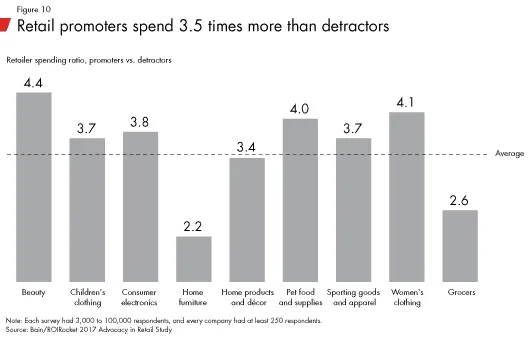
Bain and Company findings showing NPS prediction effectiveness in B2C
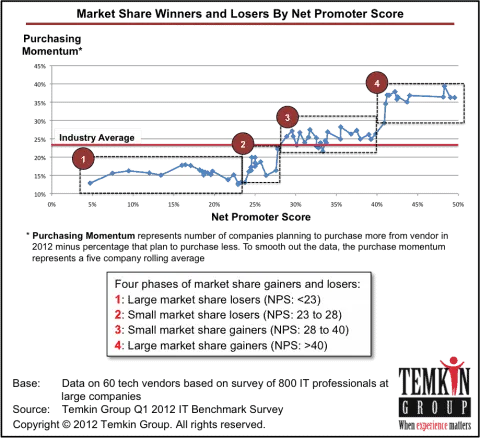
Temkin Group analysis showing NPS prediction accuracy in B2B
NPS Identifies The Drivers Of Customer Loyalty and Customer Loss
Another key benefit of NPS’s ability to predict customer loyalty is that you can use it to understand which specific processes and attributes of your product or service increase and decrease customer loyalty.
With this information you can adjust your products and services to better match what your customers want. This improves revenue and long term loyalty.
NPS Targets Unhappy Customers For Service Recovery
The ability to use a single customer loyalty question in a transactional survey allows organisations to identify specific customers who are likely to have low loyalty and low retention attributes.
Knowing who is liable to leave allows you to direct service recovery processes to resolve their issues and retain them long term.
Data collected in this process can also be used to improve scores long term, resulting in higher revenue and lower long term costs.
NPS Focuses the Organisation on Customers
Due to its easy to understand and direct approach, “would you recommend us”, NPS is easy for staff to understand and get behind.
Used consistently and positively, this helps focus everyone in the company on the customer experience.
Next Steps
Knowing NPS is worth measuring is the easy part.
The harder question is which of these nine reasons actually applies to your business, and what a realistic NPS programme would look like for it. If you want that conversation before you commit budget, book a meeting and we will talk it through.