Net Promoter Score® Survey Design and Examples
Misunderstanding Reichheld's "one number you need to grow" paper has led a lot of teams to build one-question NPS surveys. But they don't collect enough information to enable change. Drawing on hundreds of NPS survey designs across B2B and B2C, here are the elements of an effective NPS survey: one that tracks where you are and shows you how to improve.

On this page
Net Promoter Score is of course famous for being the …
The one number you need to grow…
… and this fame has led some people to think that you only need one question in your Net Promoter Survey.
This is incorrect.
A Net Promoter survey needs to be short and targeted but it also needs to have more than just one question.
I’ve designed hundreds of NPS surveys for large and small, B2B and B2C companies. Here are the key elements of a perfect Net Promoter Survey design.
Net Promoter Survey Design Goals
A lack of design goals is why so many surveys seem to have a split personality. They ask a few market research questions then a few customer feedback questions and even toss in a couple of marketing pushes.
This leads to a confused survey structure that is almost always too long and long surveys are not high response rate surveys.
Here are your Net Promoter Survey design goals:
Maximise Response Rate
The idea is to collect data so you need to maximise the number of people that respond to your survey. There are many ways to do this – here’s quick summary:
- Make it as short as possible – but remember one question is too short.
- Have a short, direct, easy to understand and act on invite.
- Ensure all the questions make sense - a more common problem than you might think.
- Ensure the invite and survey work on mobile, tablet and desktop systems.
Make It Accurate and Consistent
The factors that can skew a Net Promoter Score survey response are many and varied.
To reduce the impact of these factors as much as possible, ensure the survey is consistent from one customer to the next and one wave or transaction to the next.
Resist the urge to re-order questions, add new ones, change the wording of existing questions, etc.
Collect Information on How to Improve
You need to understand what is driving NPS if you are to use the information to improve the business.
Asking one question, as some NPS® surveys do, is pretty much a waste of time unless you have an extraordinarily deep and wide customer behaviour dataset and the tools to do some very sophisticated data analysis.
For most organisations you will need to add questions to understand what drives the score.
Questions to Exclude
There are also some elements that should be excluded from the NPS survey.
We don’t care if the customer might like to purchase that new service Marketing has been pushing or whether they follow us on Twitter.
Those questions are not relevant to the customer experience improvement process and have no place in our customer feedback survey.
Now that we have a good set of design goals the actual survey part should flow pretty easily.
The Net Promoter Score Question
Starting with the “Would Recommend” or “likelihood to recommend” question seems like a pretty good idea, and it is.
Putting this question at the start of the survey is generally considered best practice because it allows you to change later questions, if needed, and not affect the score from the first question.
The easiest approach is to just use the question as designed:
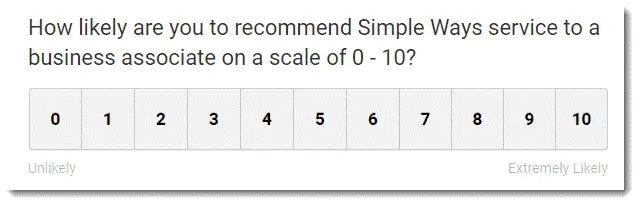
The NPS Question
Can You Change the NPS Response Scale?
Typically this is how I hear this question:
Our Market Research/Customer Insights/Analytics Department has standardised on the 0-5/1-7/Alpha-Omega, response scale and we need to conform to their requirements.
While it is possible to change the response scale, all of the analysis and published NPS literature is based on the 0-10 response scale so all of that data is worthless if you change the scale.
0-10 works and has been proven to work.
If you can push back against Market Research/Customer Insights/Analytics Department then do so.
If you can’t it’s not the end of the world but it does make things a bit tricky.
Can You Change the NPS Question Wording?
As long as you are consistent it is generally agreed that you can change the wording a minor way to focus the respondent on a particular part of the organisation or transaction.
This works quite well for transactional surveys because you can link the respondent more closely to the transaction.
It is also generally agreed that you can change the reference to a “friend or colleague” to a cohort that makes sense in the context of your business, e.g. “business colleague”, or “team mate”
However, changing the question away from the “would recommend” wording or changing the ends of the scales away from Very Unlikely or Very Likely is not generally considered acceptable.
8 Examples of Valid and Invalid Net Promoter Score Questions
Valid NPS Question – The Original Question
This is the form of the question originally published in the Harvard Business Review article.
![How likely is it that you would recommend [company X] to a friend or colleague?](/_astro/valid-nps-question-original.Ble4m5YS_Z7clOs.webp)
Valid NPS Question – The Original Question
Valid NPS Question – Links “would recommend” to a Specific Transaction
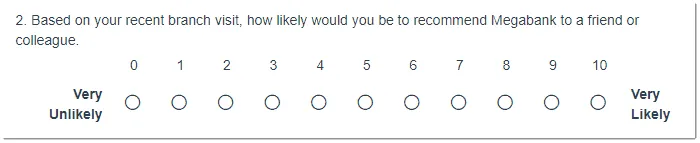
Valid NPS Question – Links “would recommend” to a Specific Transaction
Valid NPS Question – Links to Appropriate Cohort
By adding the term “team mate” this question helps focus the respondent on an appropriate cohort for recommendation.
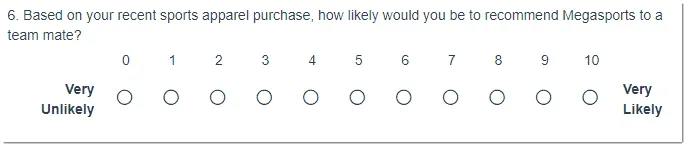
Valid NPS Question – Links to Appropriate Cohort
Valid NPS Question – Links to Appropriate Cohort
By adding the term “business associate” this question helps focus the respondent on an appropriate cohort for recommendation.

Valid NPS Question – Links to Appropriate Cohort
Valid NPS Question – Relationship Version
This question does not reference a specific transaction and becomes a good approach for a Relationship NPS survey.

Valid NPS Question – Links to Appropriate Cohort
Invalid NPS Question – Uses an “agree / disagree” construction
While this type of “agree/disagree” question construction is very common in market research it is not an appropriate way to ask the NPS question.

Invalid NPS Question – Uses an “agree / disagree” construction
Invalid NPS Question – Asks about Satisfaction
One of the goals of the original research was to find a question that correlated with loyalty better than the existing customer satisfaction approach.

Invalid NPS Question – Asks about Satisfaction
Invalid NPS Question – Asks about Loyalty
While one of the goals of the NPS research was to identify a predictor of loyalty it was discovered in that research that asking directly gave poorer outcomes than asking about “recommendation”.
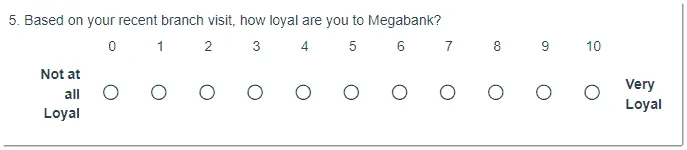
Invalid NPS Question – Asks about Loyalty
Qualitative / Free Text Question(s)
The qualitative or free text question is a staple in a Net Promoter Survey because it provides the how do we improve to match the what of the NPS tracking metric.
This is an open response question that, if the survey is well designed, will receive a 40-60% completion rate.

The NPS Survey Qualitative Question
There are nuances that you can introduce such as changing the question in response to high and low scores to the “would recommend” question, e.g.
Please tell us how we can improve.
Please tell us what you liked the most about us.
In general this is not necessary but there is no harm in doing so.
NPS Driver Identification
Driver identification is the part of the survey that tells you how to drive change, once the score has told you what to improve.
There are three main ways to run it:
- tag the free text question responses
- let customers tag their own comments
- ask attribute questions directly
Which you choose depends on your response volume and how much survey length you can spend.
1. Driver Identification by Tagging the Free Text
The first method for driver analysis is to tag each of the free text comments with a theme or themes then use these tags to analyse the data and identify the most important tags.
This requires you to tag the data and there are several ways to achieve that task.
Manual Tagging
If you don’t have many responses, maybe just one or two hundred, you can use the manual tagging approach. This works well if the same person does all of the tagging and you limit the number of tags to just 10 or 20.
Of course this is quite subjective which is why you should have the same person do the tagging to keep it consistent. As you can imagine, though, this gets old pretty quickly.
Automated Text Analytics (Passive Tagging)
Automated text analytics parses the free text responses with software instead of a person, which is what lets it scale to thousands of responses a month.
The older generation of text-analytics platforms needed training data, technical setup and ongoing management to tag correctly.
In my opinion the launch of LLM-based tools like ChatGPT and Anthropic has made those older text-analytics platforms basically obsolete.
LLMs read context rather than keywords: they catch a mixed comment like “love the product, setup was painful” and split it into separate positive and negative themes, and need far less setup to get started.
There is also no need to build and maintain exhaustive pattern matching routines, which always made the tools fragile.
But LLMs are still not point and shoot.
Someone still has to check the tags against a sample of real responses, because a model that is confidently wrong is worse than a human who is slow.
2. Customer Tagging (Active Tagging)
The second way to tag data is to have the customer complete the task. Of course you don’t call it “tagging” in the survey but that’s what they are doing.
To achieve this you add one more question to the survey with a series of check-boxes or radio buttons to allow the customer to tell you what was their biggest issue or what they liked the most.
This works very well and has the added advantage of not needing to manage text analytics tools, and never being wrong.
After all, by definition, a customer can’t tag their data incorrectly.
3. Attribute Questions
The alternative to tagging of the responses is to use a series of attribute questions to score each of the attributes of your product or service.
For example:

A Typical NPS Attribute Question
Using these scores you can determine which attributes are important to the customer and how well you are delivering them. This helps you to understand where you need to focus your improvement efforts.
This approach has the advantage of being quite clear cut to implement but the attribute list needs to be comprehensive.
The other issue with this approach is it increases the length of the survey (remember our goals). However, done carefully this works well.
Take care that you only include the attributes that are really essential otherwise you will grow a Christmas Tree survey: one with all sorts of questions hanging off it.
Attribute questions can make the task of identifying the driver attributes a little easier because the statistical analysis is relatively simple; predominately linear regression models.
Some survey guides pair this with a second question: asking the customer to rate how important each attribute is to them, then plot stated importance against performance.
We don’t ask that question.
Customers are a poor judge of their own loyalty drivers, so we derive importance statistically instead, by testing each attribute’s score against the NPS result across the whole dataset.
On one rollout, an IT company’s training scored the lowest of any attribute in the survey.
The seemingly obvious move is to fix it first.
But the statistical analysis said otherwise: the company’s documentation was good enough that training barely moved NPS at all.
Instead, we suggested the client target a mid-performing attribute. One that was important and where improvement would lift NPS.
Weight B2B Responses by an Account Value Proxy
A B2B survey that treats every response as equal is missing a key factor: account value.
Say your second-largest customer’s CEO scores you a 3, and a junior contact at one of your smallest accounts scores you a 10.
Clearly these signals have vastly different business value implications, but a simple response-weighted average doesn’t surface those differences.
An account-weighted score provides a much better insight.
Weight responses by account revenue, contract value, or strategic importance before you report the headline number.
In practice that means having B2B respondents linked to their account at the point of response, so you can bring in the account value afterwards rather than asking for it in the survey itself.
This is also why it pays to track scores by contact role inside an account, not just by account.
NPS Survey Templates
Each of the perfect Net Promoter Surveys below meets our original set of goals:
- Short
- Consistent
- Enable driver identification
- Understand how to improve
- Collect NPS
So let’s review the various versions and highlight when they should be used.
Position of the NPS Question in the Survey
Research shows a significant position effect for the “Recommend” question in surveys. In short, you get higher NPS scores if you ask the question first, lower if you ask it last in the survey.
The Minimum Possible NPS Survey
The absolute minimum effective survey combines a valid NPS question with a free text response. From there, manual tagging or automated text analysis tells you what is driving the score, which is how to improve it.
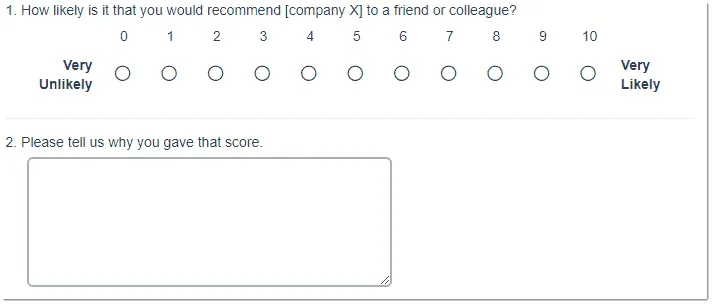
The Minimum Possible NPS Survey
Longer NPS Surveys
Once you have the minimum number of questions – if you want – you can add more questions to make the analysis of the data a little easier.
Ensure that you follow good survey design practices and don’t add too many questions.
Here’s an example of a slightly longer NPS survey that would still get good response rates while also collecting important driver information.
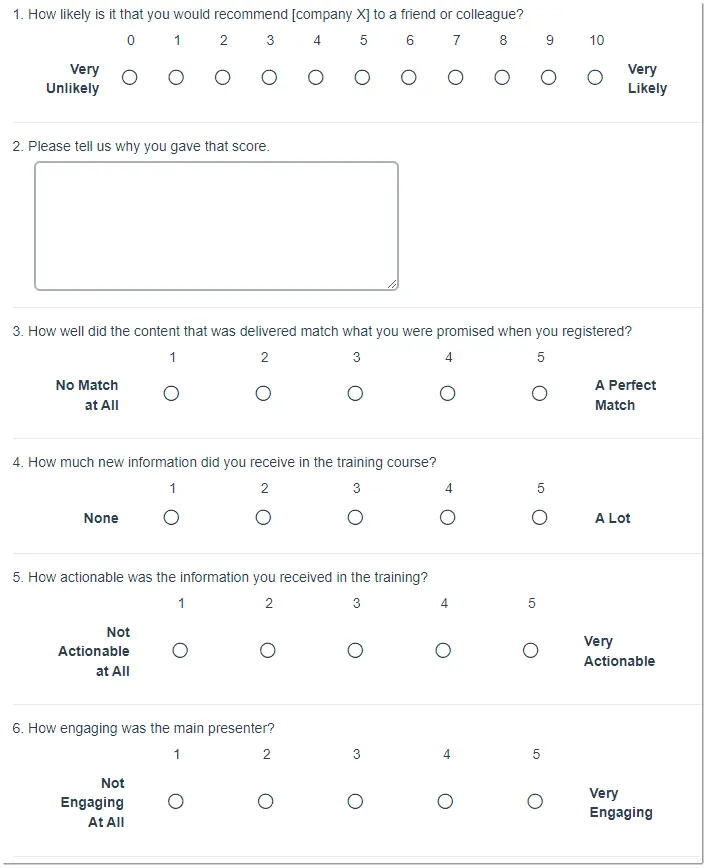
An example of a good Net Promoter Score Survey
Net Promoter Score Survey Design Questions
What is the standard Net Promoter Score survey question?
- The standard question is "How likely is it that you would recommend [company X] to a friend or colleague?", answered on a 0 to 10 scale. That is the form published in the original Harvard Business Review article. Minor wording changes are accepted where they focus the respondent on a transaction or a more relevant cohort, such as business colleague or team mate. Moving away from the would recommend wording is not.
How many questions should a Net Promoter Score survey have?
- More than one, and as few as possible after that. The minimum effective Net Promoter survey is the would recommend question plus a free text question, with manual tagging or text analytics used to find what drives the score. One question on its own tells you the what and never the why. Add driver questions only where you need them, because long surveys are not high response rate surveys.
What follow-up question should we ask after the score?
- Ask an open free text question: please tell us why you gave that score. It supplies the how behind the what, and in a well designed survey it will get a 40 to 60 per cent completion rate. You can vary it by score, asking low scorers how you could improve and high scorers what they liked most. That refinement is not necessary, but it does no harm.
Can I change the response scale for the Net Promoter Score question?
- Use 0 to 10. Some organisations change the scale to 1 to 5, 1 to 7 or other variants, and there is little evidence that it improves results. All the published Net Promoter Score analysis is based on the 0 to 10 scale, so that body of data stops applying to you. The 0 also signals which end is low, which reduces unintentional scale flipping.
Can I change the wording of the Net Promoter Score question?
- Small changes in wording are generally acceptable, particularly where they focus the respondent on an area of the business or a cohort, for example based on your recent contact centre interaction. Changing the scale endpoints, Very Unlikely and Very Likely, or the would recommend part of the question, is not advised. Be consistent, because a change part way through makes your own trend data unusable.
How often should I run a Net Promoter survey?
- Relationship Net Promoter Score surveys can run several times a year, but no more often than once every 90 days. Transactional surveys run after every transaction, with a block period so the same customer is not over surveyed. Running both keeps you current on customer feedback, shows where to improve and tracks progress over time.
How can I increase response rates to my Net Promoter Score survey?
- Start with the invitation and the survey itself. Keep the survey concise and clear, make sure the invitation and the survey read easily on mobile, tablet and desktop, and personalise the survey so it is relevant to each respondent. Accurate contact data matters as much as wording, because an invitation that never arrives cannot be answered.
Why is it important to measure Net Promoter Score?
- Measuring Net Promoter Score tells you how customers feel about your products and services, and lets you track customer loyalty over time. The value is what you change as a result: improvements to the customer experience that lift loyalty and, in time, profit. The score on its own changes nothing, which is why the process around it matters more than the number.