

We have an excellent customer lifetime value calculator, but one of the things you need to estimate lifetime value is the Customer Retention Rate.
In this post we look at the Customer Retention Rate formula, what goes into it and provide a free Customer Retention Rate calculator.

Customer Retention Rate Defined
Customer retention rate is the number of customers the company retains during a specific period divided by the number of customers they had at the start of the period. It excludes customers acquired in the period.
Customers that are not retained are often called churned customers and this occurs when a customer stops buying all products and services and becomes an ex-customer. Typically this is a negative event for the company as it reduces the businesses revenue.
Importantly this calculation is done on a cohort basis, i.e. new customers added in the period are ignored in the calculation.
Customer Retention Rate ranges from 0 to 100% – you can’t retain more customers than you had at the start of the period, nor lose more than you had at the start of the period.
Customer Retention Rate Formula
To calculate customer retention rate you need to know if the number of customers at the start of the time period in question, the number of customers at the end of the period and the number of customers added in the period.
Then use the following customer retention rate formula:


Converting Between Customer Retention Rate Time Periods
As you can see, anytime customer retention rate is quoted it needs to be accompanied by a time period, e.g.
… we had a customer retention rate of 94% for the last month…
But what if you want to compare rates quoted in different time periods, e.g. months and quarters or months and annual?
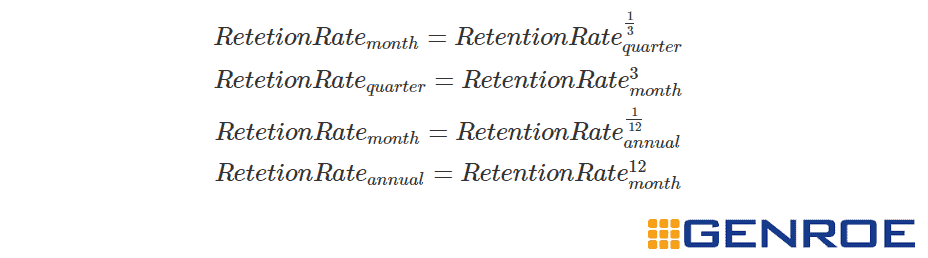
In this case you need to convert them by raising them to a power equal to the number of sub-periods or taking the equivalent mathematical roots.
Here the formulae to convert customer retention rate between common time periods:
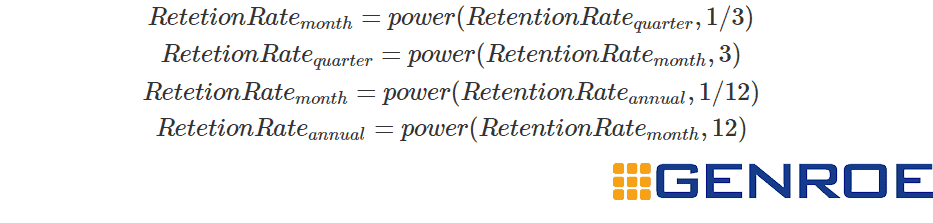
These time period conversion calculations can be done in Google Sheets or Microsoft Excel using the Power function. Here is how that looks:
Customer Churn Rate vs Customer Retention Rate
Churn Rate measures the number of customers leaving and retention rate measures the number of customers staying.
So Customer Churn Rate and Customer Retention Rate are the complement of each other. As one goes up, the other goes down.
To convert between Customer Churn Rate and Customer Retention Rate the formula is:

Customer Attrition Rate vs Customer Retention Rate
Customer Churn Rate and Customer Attrition Rate refer to the same thing – they both measure the number of customers leaving.
Customer Attrition Rate and Customer Retention Rate are the complement of each other. As one goes up, the other goes down.
To convert between Customer Attrition Rate and Customer Retention Rate the formula is:

Determining How Many Customers You Have
Each of the retention rate formulas requires knowing how many customers you have. While it might seem easy it is not always obvious how many customers you actually have.
If you’re in any type of annuity business where the client needs to cancel an ongoing service it will be clear when they have churned, because they will tell you. Examples include: SaaS software, utilities, any type of subscription business.
However, if customers don’t have an ongoing contract with then it becomes more difficult to determine if a customer is still a customer.
The chart below shows the different types of potential customer relationships. Typically it is the Contractual relationships that give the clearest indication of customers leaving.
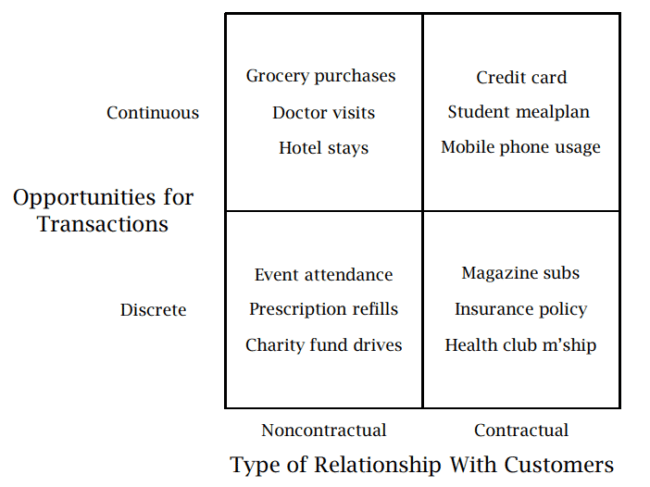
Of course some businesses have a mix of business types: retainer (contractual) clients and one-time project clients.
Here are a couple of ways of dealing with non-contractual relationships
Do we only include monthly retainer clients and not one time clients?
This depends on whether your strategy is to grow retainer or project based business.
If you are strategically focused on retainer clients and see the project work as bluebirds (good to get but not something that you are chasing) then maybe you want to leave project work out.
On the other hand if you are focused on project business you will need to determine how to tell a retained customer from a lost customer. Maybe you can make an assumption that if you get one or more projects from a company in any 24 month period then they are a current customer. That way you can tell which customers have been retained and which have left.
Do we just take the total clients at the beginning of the year and then at the end of the year and calculate it that way?
This is certainly a good option but an improvement to the process would be to look at rolling 12 month periods; January-December, February-January, etc. That way you can generate an annual retention rate and report it each month. It also means that you can reduce any annual seasonality in your reporting.
This approach also answers the “What about clients that sign on midyear?” question.
As you can see there is no right way to calculate retention rate – only the right way in the context of your business.