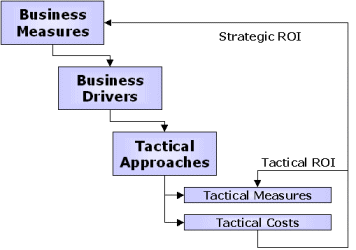

If you’re like most of the people who measure the marketing ROI on campaigns or other business initiatives, you’re probably focusing on the wrong thing: Tactical Return on Investment.
Over the last few years, there’s been an enormous amount written about return on investment- especially for marketing budgets and campaigns.
The problem is that most of it focuses on Tactical ROI and forgets all about the more important Strategic ROI. Before deciding which campaigns to tackle, you need to look at business-strategy return on investment or Strategic ROI.
Tactical ROI and Strategic ROI Defined
First some definitions:
- Tactical ROI: The return on investment for a specific action or campaign: it asks what was the ROI for that specific task.
- Strategic ROI: The return on investment from overall approaches: it asks what is the business return from an overall approach. It is easy for an action to have a very good Tactical ROI with a nil or even negative Strategic ROI.
The difference between the two is fundamental.
Unfortunately, organisations typically fall into the trap of focusing on Tactical ROI. This can result in them driving their business backwards at the Strategic level.
Let’s look at an example of the difference between the types of ROI.
This example comes from a call centre. The goals in this case were simple and predictable: lower costs and improve sales for the call centre operation in order to improve business profitability. To achieve that end, a series of training and sales fulfillment improvements were made to the business.
Four months later, the business was reviewed. Success was in the air: sales had increased and costs decreased. The Tactical ROI for the project was positive in that the call centre increased sales and lowered costs. Everyone was happy. Happy that was until someone noticed that costs had skyrocketed in post sales areas. What’s more bad debt and customer attrition had gone in the same direction.
After some investigation, it was discovered that the new customers spent much more time on the phone to the support areas because the products had not been properly explained to them. Customers either did not know what they were purchasing, left quickly or, in the worst cases, refused to pay (bad debt) because they felt they had been short-changed.
Strategic ROI for this approach was woeful.
As you can see, maximizing both Tactic and Strategic ROI is critical to business success. The role of Strategic ROI is to ensure that the approaches used generate the best ROI for the business. Once the best approaches are identified, Tactical ROI is used to ensure that the approach is executed in the most efficient way.
How To Maximize Strategic and Tactical ROI In Your Business
There are seven steps:
Step 1: Identify your Business Measures
This might sound very basic. But, of course, you must first decide on your Business Measures and goals. In this case, look at the outcomes you are trying to achieve in terms of financial indicators – profit, sales, costs, assets, etc.
Step 2: Identify Business Drivers that support your Business Measures
In this step, you need to identify those business areas that will drive your Business Measures in the right direction. The information for this task can come from market research, statistical analysis, experience, or case studies of other companies.
Examples may be increased sales, reduced customer waiting time, easier to understand product information, increase customer “satisfaction” (where “satisfaction” is a driver of increased sales), etc.
Step 3: Prioritize Business Driver impact on Business Measures
Once you have a set of Business Drivers you need to prioritize and estimate the impact of each driver on the Business Measures.
As in Step 2, this can be statistical or experience based. It doesn’t really matter because the accuracy of the estimate will be measured in later steps.
You might decide to weigh each driver as an A, B, or C priority, and assign percentage values by driver. The most important outcome is that you define your view as to the relative weighting of each Business Driver on the Business Measures.
Step 4: Create a set of Strategic ROI Measures
Once you have identified the Business Drivers, you must create a set of key measures for each driver so that you can directly and easily correlate changes in the driver with changes in the Business Measures.
For example, you might use a particular customer satisfaction rating as the Strategic ROI measure if you have chosen customer satisfaction as a Business Driver.
Step 5: Create Tactical Approaches that support Business Drivers
With an understanding of the Business Drivers, create a series of Tactical Approaches (whether you call them projects, campaigns or programmes – doesn’t matter) that will positively impact those Business Drivers.
For each of the tactical approaches, you will need to generate a set of KPIs and targets (Tactical Measures) to measure success. For instance, if the approach is a B2B marketing campaign, you will need targets in terms of relevant B2B marketing KPIs, e.g. sales made, prospects converted, etc.
Tactical ROI then, is the ROI of the Tactical Approach.
Step 6: Measure Strategic Return on Investment generated by Tactical Approaches
This step examines how the tactical approaches impact Strategic ROI so you can optimize Business Drivers.
The Tactical ROI results from each Tactical Approach should then be correlated against Business Driver changes. Then each Business Driver change should be correlated against Business Measure changes.
Using this approach it is then possible to determine exactly which Business Drivers impact on Business Measures and which Tactical Approaches impact on Business Drivers.
The important outcome from this step is that you will be able to determine the Strategic ROI for each Tactical Approach.
Step 7: Optimize Tactical Return on Investment
Once you have confirmed which are the highest impact Business Drivers and which Tactical Approaches impact the Business Drivers, you can now maximize your Tactical ROI.
Depending on the size and complexity of your business, the elements in each of these steps can be expanded or contracted to suit your needs. The important thing to note is that you should strive to maximize not just Tactical outcomes but also Strategic ones.
I've created an Excel Customer Lifetime Value Calculator: Download HereOriginally published: 4 July 2012. Last Updated: 3 November 2020